
Wait until you hear this: across the Australian rental market broadly, roughly 80% of long-term tenants prefer to bring their own furniture. If that's true, why does practically every rooming house in Brisbane show up fully furnished?! No, the answer has nothing to do with style, it's the tenant. Rooming house residents aren't always the same population as standard long-term renters, and once you understand why, you’ll realise that furnishing your rooming house can stack up better number wise.
If you're building or buying a rooming house in Brisbane, furnishing the property may seem like a small decision, until you discover how much it shapes who applies for your rooms, how quickly they lease, what you can charge and even how the property performs on paper at tax time.
At Yield Street Property Buyers, we work with clients across every stage of the rooming house journey as a specialist Brisbane buyers agency. We understand that furnishing is one of the most practical, high impact decisions an investor can make, so here's how to think it through properly, numbers and all.
The Tenant Mismatch That Will Explain Everything
Standard long-term renters, the ones in that 80% figure above, are typically settling in for years, and they'd rather bring their own bed than pay rent on someone else's. But a typical Brisbane rooming house could look different to that renter. They're typically a working professional or single person relocating for work, and generally earning somewhere around $80,000 a year, which is roughly what it takes to comfortably afford a Brisbane rooming house room. We recommend a minimum 12 month lease term, so this tenant is settling in for at least a year, but usually not for the long haul that would justify buying and later disposing of a full set of furniture.
Furnished properties in the Australian rental market currently command a premium of roughly 15% to 25% over unfurnished equivalents, according to 2026 rent-premium analysis drawing on Domain and SQM Research data. Across five rooms, that gap compounds fast, which is why furnished often selected by rooming house property investors in Brisbane.
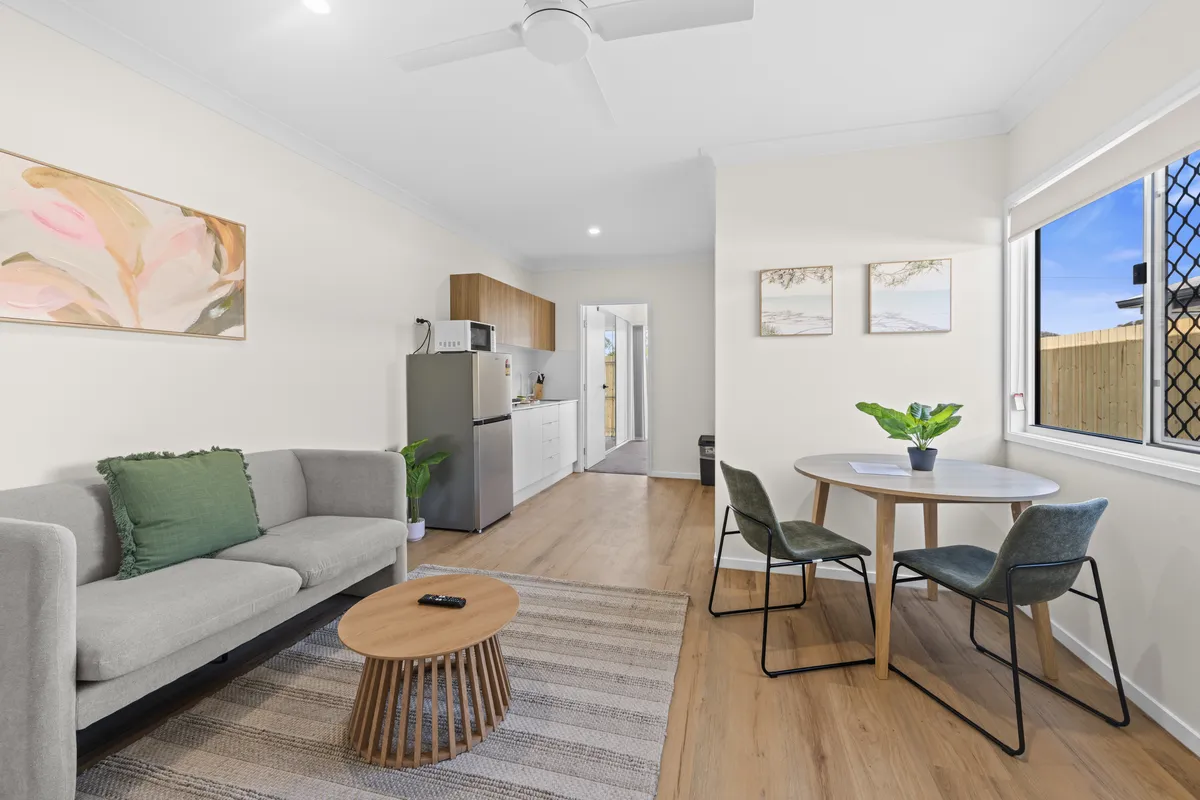
Why Most Rooming Houses in Brisbane Are Furnished
A few forces stack on top of one another here:
The tenant demographic often wants it. This tenant usually doesn't want to buy a bed, a couch and a fridge for a room they might occupy for a year or two, only to sell or dump it all again on the way out.
It reduces vacancy and speeds up leasing. A furnished, well-presented room photographs better, shows better at inspection and gives prospective tenants an immediate sense of what their life in the space will look like. In a market where every week of vacancy across five rooms adds up quickly, faster leasing has a tangible impact on your annual return.
It supports a higher weekly rent. Because the tenant isn't factoring in the cost and hassle of buying and later disposing of furniture, appliances and kitchenware, a furnished rooming house space commands a decently higher weekly rent than an equivalent unfurnished room.
It fits the ‘all inclusive’ rooming house model. Most Brisbane rooming houses are marketed with furniture, and often utilities and internet, bundled into the one weekly rent. This all-in offer is a big part of the appeal for tenants who want to move in with a bag and a laptop, not a truckload of belongings.
The Tax and Depreciation Case for Furnishing
New furniture, fittings and appliances are depreciable assets under Division 40, separate entirely from the building's Division 43 capital works depreciation, which is fixed at a flat 2.5% a year over 40 years. Plant and equipment items depreciate far faster than that. A new carpet, for example, currently has an ATO-determined effective life of 8 years, which works out to a 25% deduction in year one alone under the diminishing value method, according to the current 2025 Determination. Multiply that kind of deduction across furniture, appliances and fittings in five rooms plus common areas, and the depreciation pool materialises.
What’s more, since 1 July 2017, investors have not been able to claim depreciation on second-hand plant and equipment in established residential properties. Only brand-new items, or properties that are new or substantially renovated, still qualify for full plant and equipment depreciation. A newly built, newly furnished rooming house sits squarely in the category that still gets the full benefit, while an investor buying an older, already-furnished rooming house may find much of that depreciation has already been used up by the previous owner or isn't available to them at all.
One practical tip worth knowing before you start buying: items under $1,000 in written-down value can generally be grouped into a low-value pool and depreciated together at a simplified rate, rather than tracked individually asset by asset. For a rooming house furnishing five rooms' worth of smaller items, bedside tables, lamps, kitchenware, this can cut down the admin without giving up the deduction.
This is one of the areas where it pays to involve a quantity surveyor experienced in rooming house depreciation schedules early, ideally before you furnish, so the purchase and asset register are structured to maximise the deduction from day one.
Costs of Furnishing a Rooming House
Furnishing five individual rooms plus shared common space should never be an afterthought in your initial budget. A typical rooming house furniture package covers:
Bedroom furniture for each of the five rooms, including bed, mattress, bedside table and lamp
Living area including couch, tv, small dining table and chairs
Kitchenette appliances per room, such as a plug in cooktop, kitchenware, toaster kettle, microwave and fridge
Common area furnishings as applicable
Essential whitegoods, such as a washing machines for shared laundry use
Costs vary depending on specification and quality, but this is a five or six figure investment across a full rooming house, and a cost worth budgeting for properly from the outset. (For the full initial and ongoing cost breakdown, including construction and compliance, see our complete rooming house costs guide.)
At Yield Street Property Buyers, we offer a basic furniture package for $30,000 that covers a full five-room rooming house, and we organise everything you need to get the property furnished and ready to lease. If you're not furnishing all five rooms, we can do it room by room at $6,000 per room.
Trade-Offs Of Furnishing Your Rooming House
Furnishing isn't purely upside, so it's worth going in with a decent gage on the ongoing responsibilities.
You own the maintenance burden. Furniture, mattresses and appliances wear out and get damaged over time, especially across successive tenancies, even on the minimum 12 month lease terms we recommend. A proper condition report at move-in and move-out, and a maintenance budget for replacing worn or damaged items, both need to be factored in.
Quality matters more than it seems. Cheap furniture wears out fast, looks tired quickly and can end up undermining your ability to attract and retain the tenant you want. Durable, hard-wearing materials and considered styling cost more upfront but reduce replacement costs and support stronger tenant retention over the life of the investment.
The Furnish-Once-Furnish-Right Framework
If you take one thing from this article, let it be this: the decision that actually matters isn't whether to furnish, it's how you furnish. A quick framework we use with clients:
1. Match the spec to the tenant, not the trend. A rooming house tenant wants durable and comfortable, not curated and Instagrammable. Spend where it affects durability and comfort, not where it just looks good in a listing photo.
2. Buy new, and keep every invoice. Beyond the finance and warranty benefits, it's what preserves your Division 40 depreciation entitlement in full. This is not the place to furnish from a garage sale.
3. Loop in your quantity surveyor before, not after. Structuring the purchase and asset register properly from day one is what actually maximises the deduction, rather than trying to reconstruct it later.
4. Budget for replacement, not just initial purchase. Set aside an ongoing maintenance allowance from the start, so a worn mattress in year three becomes a line item.
Our View at Yield Street Property Buyers
For most Brisbane rooming house investments, we recommend furnishing. It's what much of the tenant market expects, it supports faster leasing and stronger weekly rent, and it comes with a real depreciation benefit, one that's stronger for a new build than an established one and that improves your after-tax return. That said, it isn't all or nothing. Some investors elect to furnish only some of the rooms and leave the rest empty, whether to stage the spend across a couple of years or to test how the local tenant pool responds, which is why we price furnishing on a per room basis as well as a full package.
As a Brisbane buyers agent working specifically in this space, we help clients budget for furnishing properly from the outset, handle the furniture package in house so the whole fit out is managed for you, and work alongside quantity surveyors who know how to structure the purchase for the strongest depreciation outcome. Getting this right from the outset avoids the common trap of underbudgeting for furnishing early, then facing a scramble, and a compromise on quality, right before your first tenants move in.
Get the Right Advice Before You Furnish
Furnishing decisions are easy to get wrong at both ends of the spectrum. On one end, there’s spending too little and compromising tenant appeal and durability. On the other, there’s spending without a plan and eroding your return before you've even leased the first room. If you're planning a rooming house investment in Brisbane and want guidance on furnishing, budgeting and depreciation done properly, get in touch with Yield Street Property Buyers. As your independent Brisbane buyers agency, we'll connect you with the right team and ensure every dollar you spend on furnishing is working just as hard as you are for your return.
This article is general information only and does not constitute financial, taxation or legal advice. Depreciation outcomes depend on individual circumstances. Always seek advice from a qualified accountant or quantity surveyor specific to your investment before making purchasing decisions.